“Some people believe football is a matter of life and death, I am very disappointed with that attitude. I can assure you it is much, much more important than that.” – Bill Shankly
As a boy, born in a working-class town in the North West of England, I can only agree with the ex-Liverpool manager.
For me, football was life. When I wasn’t watching it, I was playing it. When I wasn’t playing it, I was talking about it. When I wasn’t talking about it, I was thinking about it. You get the idea.
I often wonder why we Brits take our football so seriously.
To the uninterested, football is little more than 22 men kicking a bag of air around for 90 minutes. I scoff at such a crude description of the beautiful game. Boiling football down to its core mechanics is an over-simplification worthy of a flogging, in my book.
Football is about community. It’s about congregating at your chosen temple, experiencing your shared passion with your fellow sufferers. Every tackle, every miss, every rattled post and every goal; football is the great equaliser. Rich or poor, different beliefs, none of that matters. Come 3pm on a Saturday, we’re all the same.
Anyway, I digress. This post isn’t really about football.
Rather, it’s about those forgotten areas of wasteland where, as kids, we relive the weekend exploits of our heroes. A small patch of nothing, which to a young imaginative mind is everything. A place to throw your jumpers on the ground, spaced roughly at the distance you would imagine a real goal line to be. A place to gather in the middle and pick your teams, swiftly signalling to the least talented player exactly where they had to stand in between those jumpers. Those little pockets of land were no longer just a vacant space behind people’s houses – they became our Wembley.
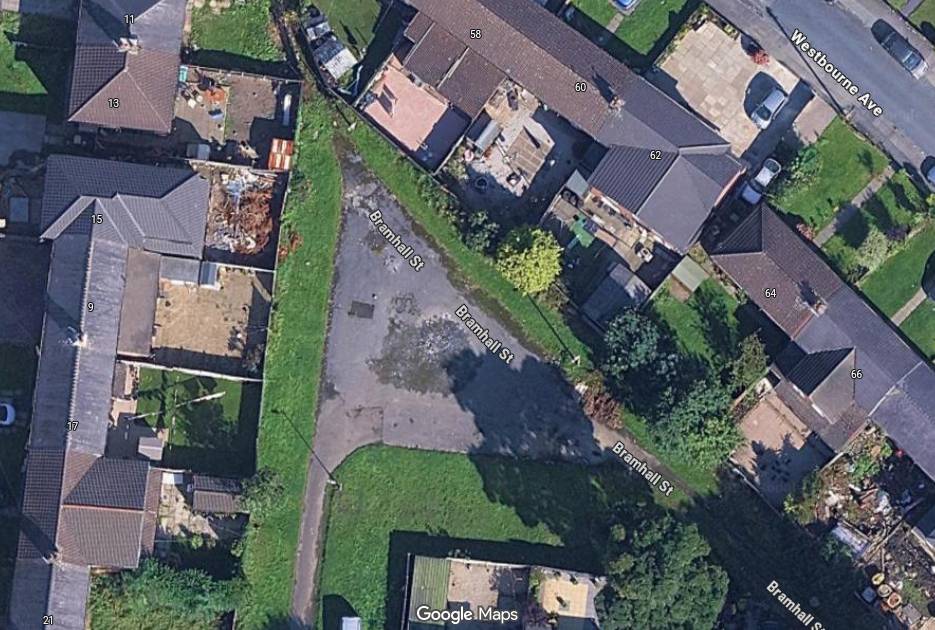
For a few years in the early 1990s, this was my Wembley. A place lovingly referred to as ‘The Back Field’ or ‘Back Fee[sic]’ by the local kids of the time.
I’ll address the elephant in the room straight away. You’re correct. It’s not a field. There are grass elements, sure, but to call it a field might be a bit of a stretch. Heck, to call it a ‘Fee’ is probably too far. But that’s not important. It was a place of nothing turned into something. A piece of discarded wilderness reclaimed by youthful ambition.
Geometrically it shouldn’t work; even those who have no interest in football know that the dimensions of the playing surface are rectangular. Kids don’t care about geometry though, they only care about having a space in which to express themselves.
As I have gotten older (I’m in my early 40s now), I find that somehow the longing ache of nostalgia grows. It has become almost painful. I have nothing but happy memories of that time… of that place. However, should I ever sit to think about it for any length of time, I feel an almost melancholic sadness.
A sentiment which might seem slightly hyperbolic, sure. It’s a scrap of old concrete which, for a short period in the early 1990s, was a place to have a kickabout and for the local residents to have a bonfire on Guy Fawkes Night (see big scorched patch in the middle of the concrete triangle). But it was my scrap of concrete.
The melancholic-tinged sadness comes from a longing for a simpler time. A time when the weight of the world didn’t matter. The only issue which presented itself was whether you could find a place to play and whether or not you had enough players to make a game. There were no worries about work, taxes or balancing the daily grind of family life. It was innocent and free.
I know that, but it doesn’t make it not hurt.
I don’t know this for sure, but I doubt the Back Field is utilised as a makeshift football stadium by kids today. There are far more immediate things competing for a child’s attention these days. In the era of instantaneous fun, the need to go out and create your own has gone. Those places which we had to find to express ourselves are now virtual worlds where games are played and videos are shared. I don’t know if that’s better or worse.
I like to think that, much like me, the Back Field hasn’t forgotten. I love that the scorched concrete is still holding on to its history, telling a story long forgotten except by those who were there.

